

Mathematics is built on clear rules that simplify complex problems. One of the most important concepts in calculus is the product rule, a fundamental differentiation rule used when multiplying two functions together. Whether you are a high school student, college learner, or competitive exam candidate, mastering the product rule is essential for solving advanced mathematical problems.
In this comprehensive guide, we will explore the formula, derivation, step-by-step examples, common mistakes, real-world applications, and comparison with other differentiation rules. By the end, you will have complete clarity about how and when to apply it correctly.
What Is the Product Rule?
The product rule is a differentiation formula used when you need to find the derivative of the product of two functions.
If you have:
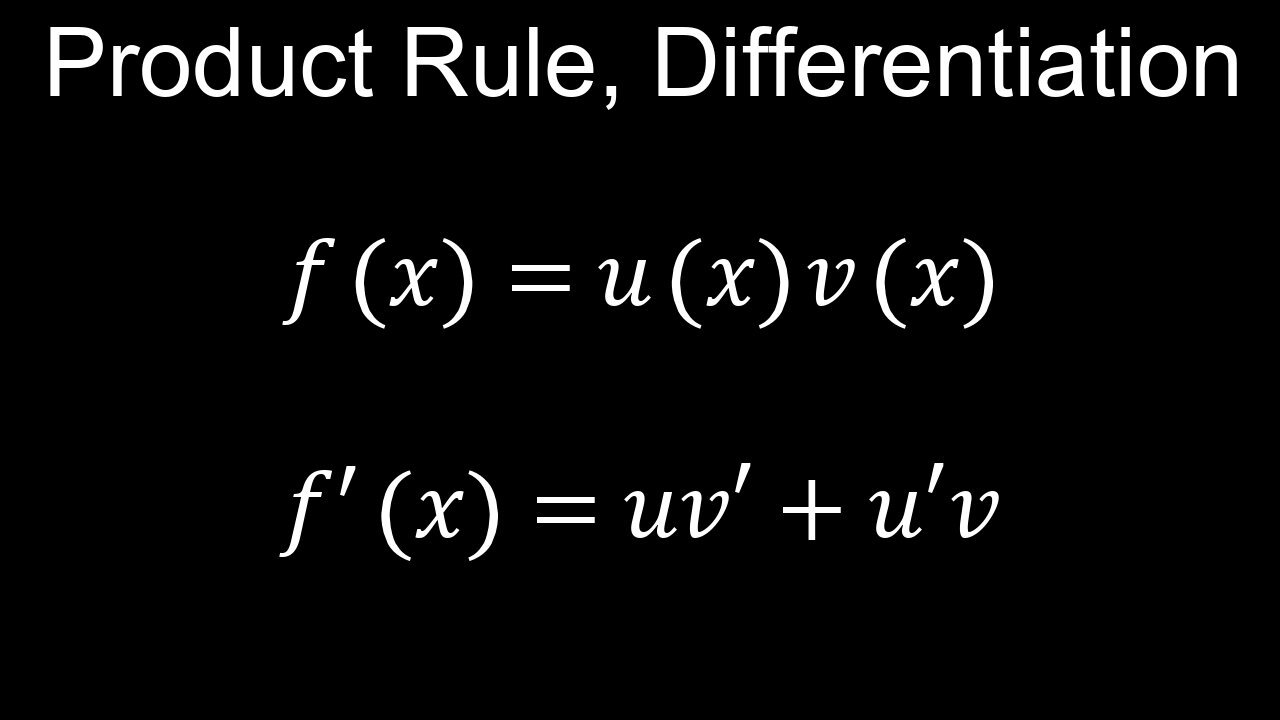
f(x) = u(x) · v(x)
Then the derivative is:
f'(x) = u'(x)v(x) + u(x)v'(x)
In simple words:
Differentiate the first function and multiply by the second, then add the first function multiplied by the derivative of the second.
This rule applies only when two functions are multiplied together.
Why the Product Rule Is Important
Understanding the product rule is crucial because many real-world mathematical expressions involve multiplication of functions.
It is important for:
- Calculus problem solving
- Engineering calculations
- Physics equations
- Economics modeling
- Machine learning mathematics
Without this rule, differentiating complex expressions would become extremely difficult.
Product Rule Formula Explained Clearly
Let’s break down the formula step by step.
If:
u(x) = first function
v(x) = second function
Then:
d/dx [u(x)v(x)] = u'(x)v(x) + u(x)v'(x)
This means:
- Differentiate u(x), keep v(x) same
- Keep u(x) same, differentiate v(x)
- Add both results
The structure prevents mistakes when dealing with multiplied functions.
Product Rule Derivation (Conceptual Understanding)
To deeply understand the product rule, consider small changes in functions using limits.
If:
f(x) = u(x)v(x)
Using the limit definition of derivative:
f'(x) = lim h→0 [(u(x+h)v(x+h) − u(x)v(x)) / h]
After algebraic manipulation, it simplifies into:
u'(x)v(x) + u(x)v'(x)
This shows that the rule is not random — it is mathematically derived from first principles.
Basic Product Rule Examples
Understanding theory is good, but examples make it clear.
Example 1: Simple Polynomial Product Rule
Find derivative of:
f(x) = x² · x³
Step 1: Identify functions
u(x) = x²
v(x) = x³
Step 2: Differentiate
u'(x) = 2x
v'(x) = 3x²
Step 3: Apply formula
f'(x) = (2x)(x³) + (x²)(3x²)
Simplify:
= 2x⁴ + 3x⁴
= 5x⁴
This confirms the rule works correctly.
Example 2: Product_Rule with Trigonometric Function
Find derivative of:
f(x) = x sin(x)
Step 1:
u(x) = x
v(x) = sin(x)
Step 2:
u'(x) = 1
v'(x) = cos(x)
Step 3:
f'(x) = (1)(sin x) + (x)(cos x)
Final Answer:
sin(x) + x cos(x)
Advanced Product_Rule Examples
Example 3: Exponential and Polynomial Product_Rule
f(x) = x² eˣ
u(x) = x²
v(x) = eˣ
u'(x) = 2x
v'(x) = eˣ
Apply rule:
f'(x) = (2x)(eˣ) + (x²)(eˣ)
Factor:
= eˣ(2x + x²)
Example 4: Product_Rule with Logarithmic Function
f(x) = x ln(x)
u(x) = x
v(x) = ln(x)
u'(x) = 1
v'(x) = 1/x
Apply:
f'(x) = (1)(ln x) + x(1/x)
Simplify:
= ln(x) + 1
When to Use the Product_Rule
You must use the product rule when:
- Two functions are multiplied
- Expression cannot be simplified first
- Both parts depend on x
Do NOT use it when:
- You have a quotient (use quotient rule)
- A function is raised to a power (use chain rule if needed)
Understanding when to apply it prevents mistakes.
Product_Rule vs Chain Rule
Many students confuse these two rules.
Product Rule:
Used when two functions are multiplied.
Example:
x² sin(x)
Chain Rule:
Used when one function is inside another.
Example:
sin(x²)
In some cases, both rules are required together.
Common Mistakes in Product_Rule
Avoid these common errors:
1. Forgetting to Add Both Terms
Some students only differentiate one part.
2. Not Applying Correct Derivatives
Check derivatives carefully.
3. Sign Errors
Especially with trigonometric functions.
4. Ignoring Simplification
Factor when possible to make answer cleaner.
Product_Rule in Real Life Applications
The product rule is not just theoretical. It appears in:
1. Physics
Used in:
- Velocity and acceleration problems
- Work-energy calculations
- Electromagnetic equations
2. Economics
Used to model:
- Revenue functions
- Cost analysis
- Marginal profit
3. Engineering
Applied in:
- Signal processing
- Mechanical system modeling
- Electrical circuit analysis
Higher Order Product_Rule
If you need second derivative:
Differentiate the first derivative again using product rule.
Example:
If:
f'(x) = u'(x)v(x) + u(x)v'(x)
Then apply rule again carefully.
This becomes more advanced but follows same pattern.
Product Rule Shortcut Trick (Memory Tip)
Remember this phrase:
“First derivative of first times second, plus first times derivative of second.”
Or simply:
(First’ × Second) + (First × Second’)
This memory trick helps during exams.
Practice Questions for Product_Rule
Try solving these:
- f(x) = x³ cos(x)
- f(x) = eˣ ln(x)
- f(x) = x² tan(x)
- f(x) = (x + 1)(x² − 3x)
Practicing improves accuracy and speed.
Step-by-Step Strategy to Master Product_Rule
- Identify two functions clearly
- Write derivative formula before solving
- Differentiate separately
- Substitute carefully
- Simplify answer
Following structured steps reduces mistakes.
Why Students Struggle with Product_Rule
Common reasons include:
- Confusing with chain rule
- Rushing steps
- Weak derivative basics
- Lack of practice
The solution is consistent practice and understanding concept deeply.
Product Rule in Competitive Exams
In exams like:
- SAT (advanced sections)
- GRE quantitative
- Engineering entrance tests
- University calculus exams
The product rule frequently appears in differentiation problems.
Being confident with it saves time and boosts score.
Frequently Asked Questions About Product_Rule
What is the formula of product rule?
f'(x) = u'(x)v(x) + u(x)v'(x)
Can product rule apply to three functions?
Yes, extend the pattern carefully.
Is product rule used in integration?
No, integration uses different methods.
Can product rule combine with chain rule?
Yes, in complex expressions.
Final Thoughts on Product_Rule
The product rule is one of the foundational pillars of calculus. It allows you to differentiate multiplied functions accurately and efficiently. From academic exams to engineering applications, mastering this concept strengthens your mathematical problem-solving skills.
The key is practice, clarity, and structured steps.
Once you fully understand how and why it works, even complex derivatives become manageable.
Keep practicing regularly, and you’ll find that the product rule becomes second nature.
