

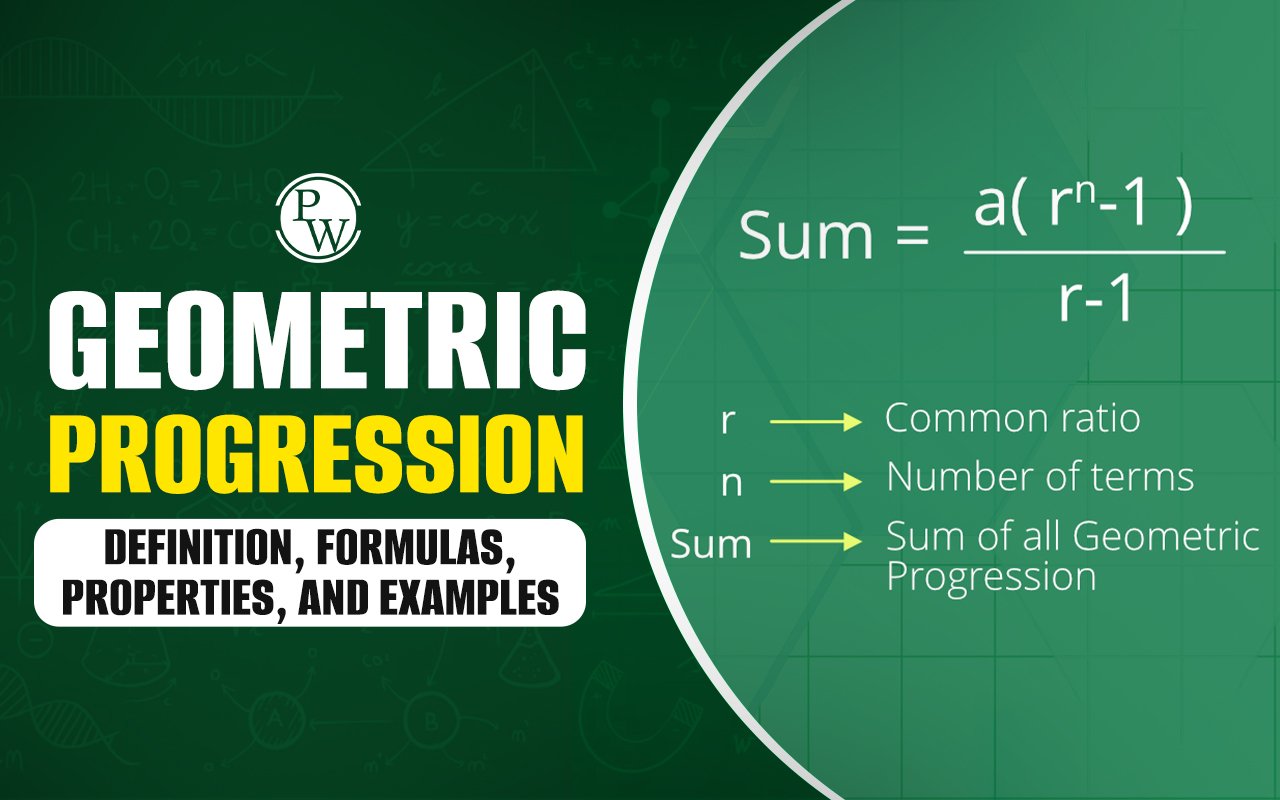
A geometric sequence is one of the fundamental concepts in mathematics, widely used in algebra, finance, physics, and computer science. Understanding geometric sequences helps students and professionals analyze patterns, predict outcomes, and solve real-world problems. In this article, we will explore what a geometric sequence is, its formula, properties, examples, applications, and advanced concepts.
What is a Geometric Sequence?
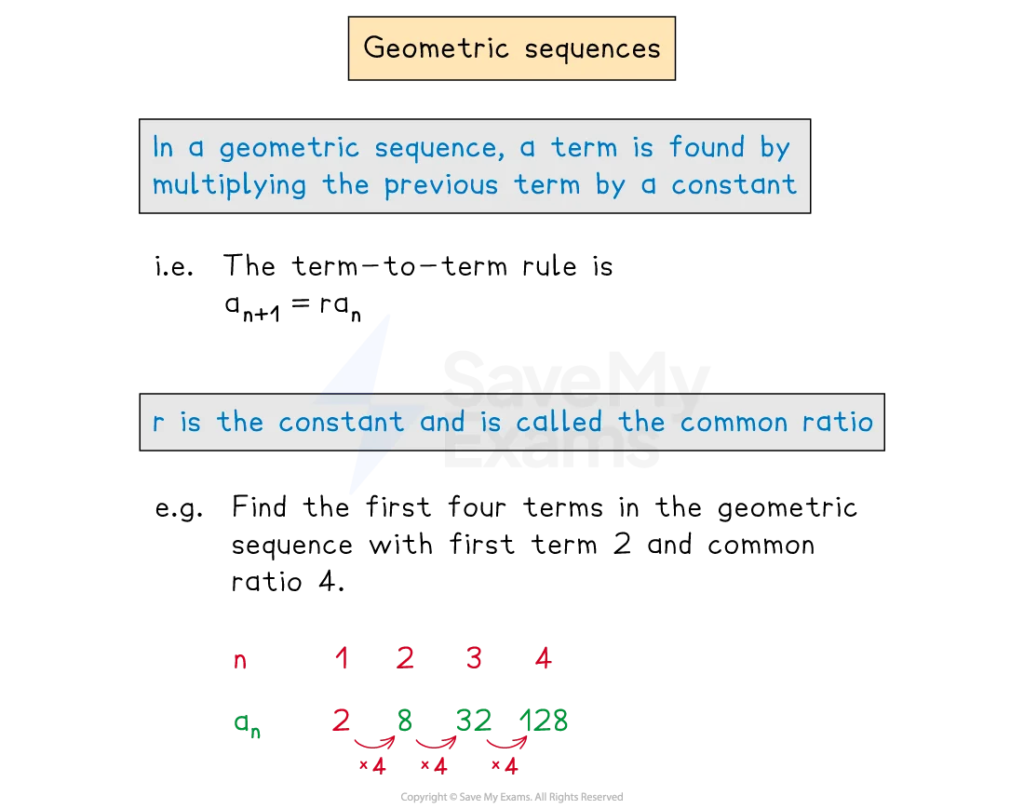
A geometric sequence is a sequence of numbers in which each term after the first is obtained by multiplying the previous term by a constant value called the common ratio. Unlike an arithmetic sequence, where the difference between consecutive terms is constant, the geometric sequence grows or decreases exponentially depending on the common ratio.
For example, the sequence 2, 4, 8, 16, 32 is a geometric sequence because each term is multiplied by 2 to get the next term. Here, the common ratio r=2.
General Formula of a Geometric Sequence
The general formula of a geometric sequence is essential to understand and calculate terms in the sequence without listing all previous numbers. The formula is:an=a1⋅r(n−1)
Where:
- an = nth term of the sequence
- a1 = first term of the sequence
- r = common ratio
- n = term number
This formula allows quick calculation of any term in the sequence. For instance, in a geometric sequence starting with 3 and a common ratio of 5, the 6th term is:a6=3⋅5(6−1)=3⋅55=3⋅3125=9375
Properties of a Geometric Sequence
Understanding the properties of a geometric sequence helps in identifying sequences and solving problems efficiently. Key properties include:
- Constant Ratio: Each term is obtained by multiplying the previous term by the common ratio r.
- Exponential Growth or Decay: If ∣r∣>1, the sequence grows exponentially. If ∣r∣<1, the sequence decays toward zero.
- Sign Alternation: If r is negative, the terms of the sequence alternate in sign.
- Non-Linear Pattern: Unlike arithmetic sequences, geometric sequences do not have a constant difference but a multiplicative factor.
Examples of Geometric_Sequences
Let’s explore some examples of geometric_sequences to better understand the concept:
- Example 1: 3, 6, 12, 24, 48
- Common ratio r=2
- Example 2: 81, 27, 9, 3, 1
- Common ratio r=1/3
- Example 3: 5, -10, 20, -40
- Common ratio r=−2
Each example illustrates the basic principle: multiply the previous term by the same ratio to get the next term.
Sum of a Geometric _Sequence
The sum of a geometri_sequence is a crucial concept in mathematics, especially for financial calculations and series analysis. There are two types: the sum of a finite geometric sequence and the sum of an infinite geometric series.
Sum of a Finite Geometric_Sequence
The sum of the first n terms of a geometric_sequence is given by:Sn=a1⋅1−r1−rnfor r=1
Where Sn is the sum of the first n terms.
Example: Sum of the first 5 terms of the sequence 2, 4, 8, 16, 32:S5=2⋅1−21−25=2⋅−11−32=2⋅−1−31=62
Sum of an Infinite Geometric Series
If the absolute value of the common ratio is less than 1 (∣r∣<1), the geometric_sequence can be extended infinitely, and the sum converges to a finite value. The formula is:S∞=1−ra1for ∣r∣<1
Example: Sum of 1 + 1/2 + 1/4 + 1/8 + …S∞=1−1/21=1/21=2
Geometric_Sequence in Real Life
Geometric_sequences are not just theoretical—they appear frequently in real-life situations:
- Finance: Compound interest uses geometric sequences to calculate accumulated interest over time.
- Population Growth: Populations of species can grow geometrically under ideal conditions.
- Physics: Radioactive decay follows a geometric pattern based on half-life calculations.
- Computer Science: Binary growth, such as doubling of data storage or processing power, can be modeled using geometric sequences.
- Architecture: Geometric sequences appear in design patterns, such as spiral staircases or fractal structures.
How to Identify a Geometric_Sequence
Identifying a geometric_sequence is simple once you understand the key indicators:
- Divide Consecutive Terms: If the ratio between consecutive terms is constant, it’s geometric.
- Look for Exponential Pattern: If the sequence multiplies or divides consistently, it’s geometric.
- Check for Alternating Signs: If the terms alternate signs but maintain a constant absolute ratio, it’s a geometric sequence.
Example Check: Is 5, 10, 20, 40 a geometric sequence?510=2,1020=2,2040=2
Yes, the common ratio is 2.
Advanced Concepts in Geometric_Sequences
For students and professionals dealing with higher-level mathematics, geometric sequences have advanced applications:
- Geometric Mean: In a geometric_sequence, the square root of the product of two consecutive terms gives the geometric mean.
- Example: In 2, 6, 18, the geometric mean of 2 and 18 is 2⋅18=6.
- Recursive Formula: Geometric sequences can also be expressed recursively: an=r⋅an−1,a1 given
- Applications in Calculus: Geometric_sequences help in summing series, solving limits, and analyzing convergence.
Common Mistakes in Geometric_Sequences
When working with geometric sequences, beginners often make mistakes:
- Confusing with Arithmetic_Sequences: Arithmetic sequences add a constant, while geometric sequences multiply by a constant.
- Wrong Formula for Sum: Using the wrong formula for finite or infinite sums can lead to errors.
- Ignoring Sign of Common Ratio: A negative ratio affects alternation of signs and sum calculation.
Being aware of these pitfalls helps in solving problems accurately.
Practice Problems on Geometric_Sequence
Here are some practice problems to reinforce your understanding:
- Find the 10th term of the geometric sequence: 3, 6, 12, …
- Calculate the sum of the first 8 terms of the sequence: 5, 15, 45, …
- Determine whether the following is a geometric sequence: 81, 27, 9, 3, 1
- Find the sum of the infinite geometric series: 1 + 1/3 + 1/9 + 1/27 + …
Solving these problems helps in mastering the concept of geometric_sequences for exams and real-life applications.
Geometric_Sequence in Technology and Nature
Geometric sequences are prevalent not only in math but also in technology and nature:
- Technology: Algorithms that double memory or processing power follow geometric patterns.
- Nature: Growth patterns in plants, shells, and crystal formations often follow geometric sequences.
- Economics: Investment growth and compound interest calculations rely on geometric sequences for predictions.
These applications highlight the importance of understanding geometric_sequences beyond classroom mathematics.
Conclusion
A geometric_sequence is a powerful mathematical concept with widespread applications in science, finance, technology, and nature. Understanding its formula, properties, and applications equips students, professionals, and enthusiasts to analyze patterns, solve complex problems, and make informed predictions.
From calculating the sum of a geometric series to modeling real-world exponential growth, mastering geometric sequences is essential for anyone looking to deepen their mathematical skills.
By practicing problems, exploring applications, and understanding the properties, you can confidently work with geometric sequences in both academic and real-life scenarios.
