
Introduction
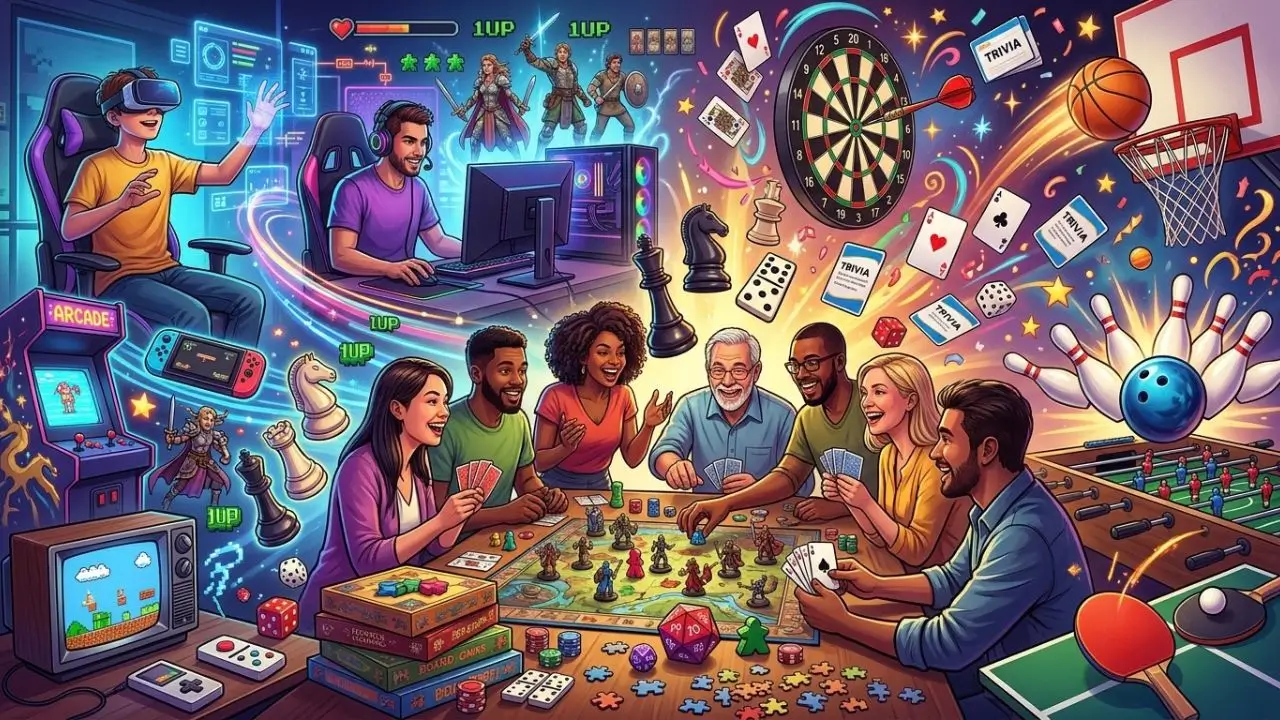
Games can take many different forms. For some, a game means a quick round on a smartphone; for others, it involves a long journey through an expansive virtual world. A game might demand dexterity, tell a story, foster strategic thinking, or simply provide a few minutes of relaxation. It is precisely this immense variety that makes the world of gaming so fascinating.
From classic board and card games to modern PC, console, and mobile titles, there are countless ways to engage in gaming. Some titles are designed for a single player, while others truly come into their own when played with friends. The time commitment varies significantly, too: a session might last five minutes or stretch over many hours.
Making the right choice, therefore, depends on more than just age or the platform being used. Key factors include personal interests, preferred game mechanics, available time, and the type of challenge you are looking for. This guide outlines the major types and genres of games, explains what distinguishes them, and shows how to find games that truly suit your personal playstyle.
1. What are games, and why are there so many different types?
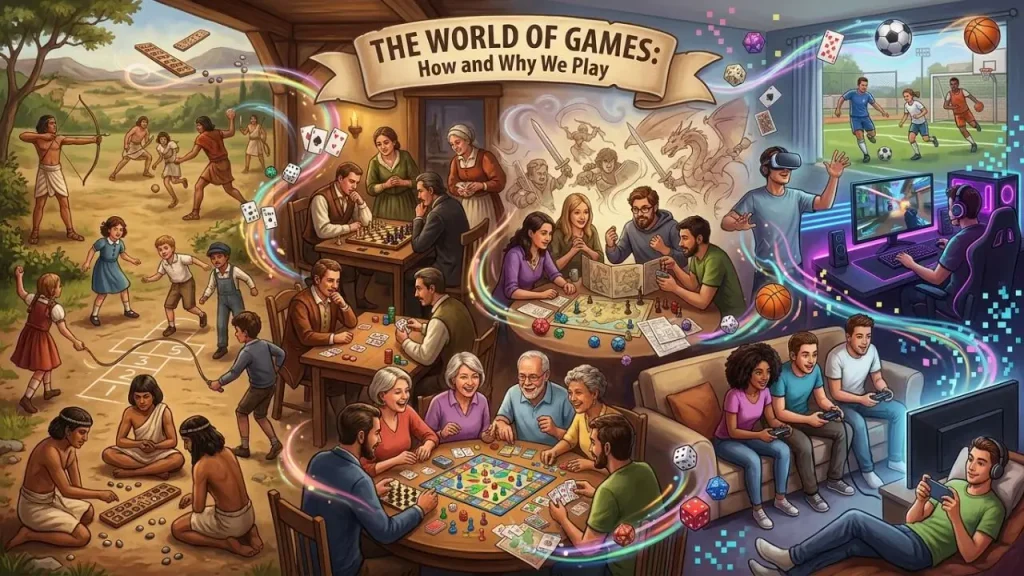
The term “games” encompasses far more than just classic video games. Fundamentally, a game is a structured activity defined by specific rules, goals, or challenges. Players make decisions and experience varying outcomes depending on the game. In digital games, software takes on additional tasks—such as rendering the game world, managing rules, and responding to player input.
Video games have evolved into a particularly diverse form of play. A simple puzzle game might be completed in just a few minutes, whereas a role-playing game offers a vast world filled with characters, quests, and various narrative choices. Between these extremes lie numerous other genres, including sports games, strategy games, racing games, simulations, horror games, and adventure games.
Game Mechanics and the Player Experience
A key distinguishing factor is game mechanics—that is, what the player actually has to do. In a racing game, for instance, you control a vehicle and try to complete a course as successfully as possible. In a strategy game, you might need to manage resources, deploy units, or make long-term decisions.
However, the player experience is shaped by more than just mechanics. Music, graphics, atmosphere, story, and characters can also play a significant role. Consequently, a game with simple rules can still have a powerful emotional impact.
The degree of player freedom also varies from genre to genre. Some games set clear objectives, while others offer vast open worlds where players can decide for themselves what to do next. These differences ensure that people with widely varying preferences can find games that suit their tastes.
2. An Overview of Key Game Genres
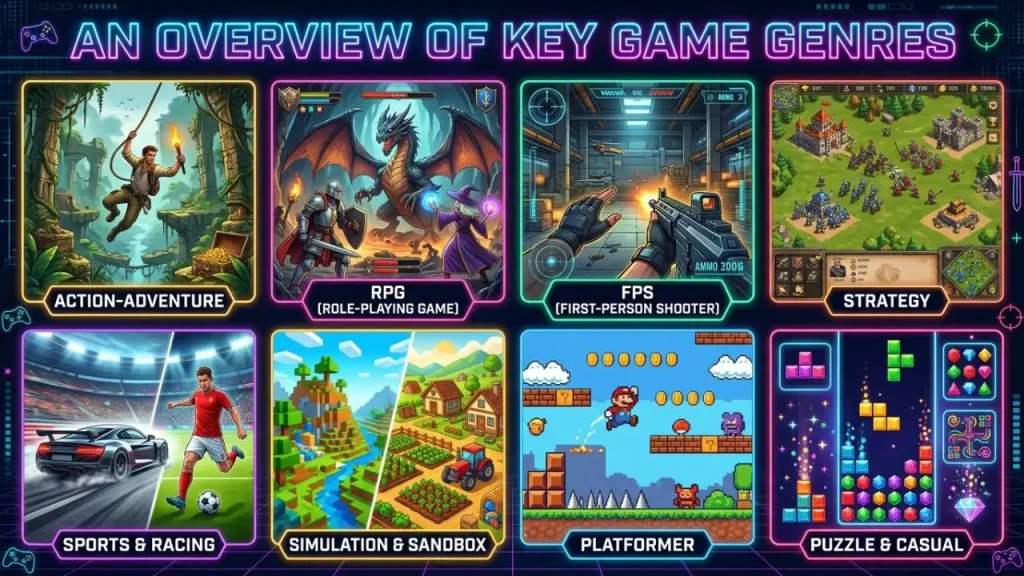
The world of gaming can be divided into numerous genres. Action games, for instance, focus on quick reactions, combat, or dynamic situations. Players often have to make decisions within a short timeframe. Within this category, there are various sub-genres, ranging from classic platformers to complex action-adventure games.
Adventure games, by contrast, tend to place greater emphasis on exploration, puzzles, and storytelling. Players explore environments, interact with characters, and complete tasks to advance the plot. Story-driven adventure games can be particularly compelling when the narrative plays just as important a role as the gameplay challenges.
Role-playing games—or RPGs—often combine character development, exploration, and decision-making. Players can strengthen their characters, acquire new skills, or obtain better equipment. Some RPGs also feature extensive dialogue systems and choices that influence specific parts of the story.
Those who prefer games with strong narratives, interesting characters, and emotional stories will find a particularly large number of suitable experiences among story-driven games.
Strategy, Sports, and Simulation
Strategy games often require patience and planning. Rather than simply reacting quickly, players must consider which decisions make sense in the long run. Real-time strategy and turn-based strategy games take different approaches here; while decisions in real-time games often need to be made instantly, turn-based systems allow more time for reflection.
Sports games bring familiar sports into a digital environment. Soccer, basketball, tennis, golf, and motor racing are among the most well-known examples. Some titles aim to replicate real-world rules as accurately as possible, while others deliberately prioritize entertainment value and simplified mechanics.
Simulations, meanwhile, focus on replicating specific activities or systems. A game might, for example, simulate the operation of a city, a farm, an airport, or a business. The appeal often lies in understanding a system and then managing it oneself.
3. PC, Console, and Mobile Games: Which Platform Fits Best?
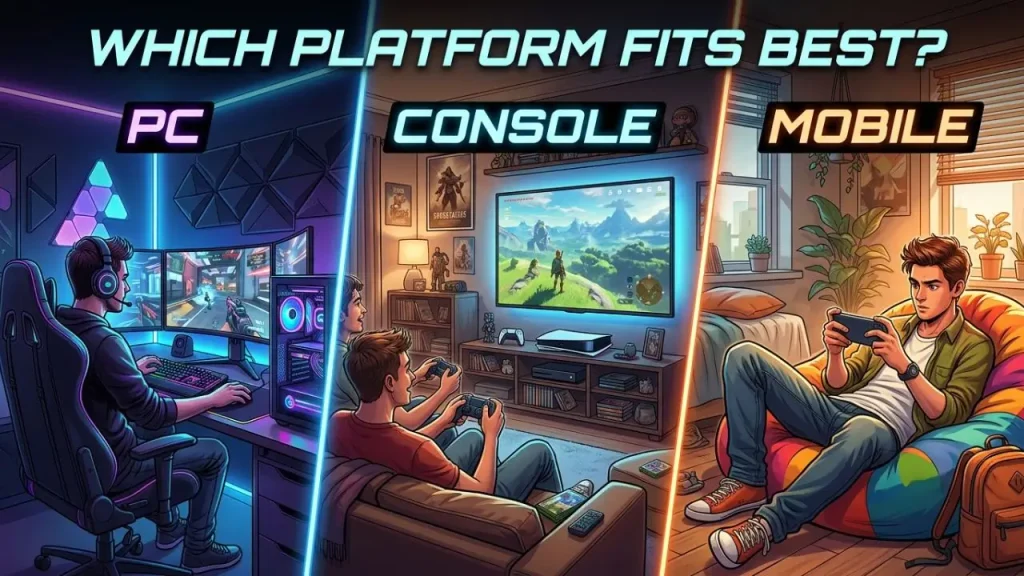
The choice of platform significantly influences how games are played. PC games often offer extensive customization options; depending on their hardware, players can adjust resolution, graphics quality, and other settings. Furthermore, the PC hosts a vast array of genres, ranging from strategy games and simulations to major multiplayer titles.
Another advantage of the PC is the variety of input devices available. A mouse and keyboard, for instance, are excellent for strategy games or certain action titles. Conversely, a controller might offer a more comfortable experience for racing games, platformers, or many third-person games.
Consoles rely more on a closed system. Players need not worry as much about hardware compatibility, allowing them to focus more on the game itself. Modern consoles also support online multiplayer, digital game libraries, and various convenience features.
Mobile Games and Short Play Sessions
Smartphones and tablets have made gaming even more accessible. Mobile games can be played virtually anywhere, provided the device and the specific app meet the necessary requirements. Games suited for short play sessions are particularly popular.
Puzzle games, card games, strategy games, and casual games often work well on mobile devices. Touchscreens allow for direct input, which is ideal for simple game mechanics. At the same time, there are now more extensive mobile games available that are significantly more complex than classic casual games.
Ultimately, the platform should suit your personal gaming habits. Those who prefer long sessions involving complex controls might feel more at home with a PC or console. In contrast, those looking to play in short bursts will find a wide range of straightforward options on smartphones.
4. Single-player, multiplayer, and playing together

Not every game needs to be played with others. Single-player games focus on a single player and can be particularly well-suited for those who prefer to play at their own pace. Narrative-driven games often benefit from this format because the storyline does not depend on other players.
A single-player game can also create a highly controlled atmosphere. Developers can precisely tailor the world, music, and plot to the player’s progress. Players decide for themselves when to take a break and how quickly to complete specific tasks.
Multiplayer games, on the other hand, rely on interaction with other people. This can center on either cooperation or competition. In a cooperative game, for instance, multiple players must work together to achieve a goal, whereas competitive games pit teams or individual players against one another.
Why playing together can be so much fun
The social element significantly changes the gaming experience. A simple task can become more engaging when two or more people brainstorm, laugh, or react to unexpected situations together.
Communication is often crucial in cooperative games. Players must assign roles, share information, and respond to one another. As a result, even familiar game mechanics can feel completely different than they do in single-player mode.
However, multiplayer games also come with challenges. A stable internet connection may be required, and the behavior of other players cannot be controlled. Therefore, it is wise to choose a game with a community and style of play that align with your own expectations.
5. How do you find games that really suit your playstyle?
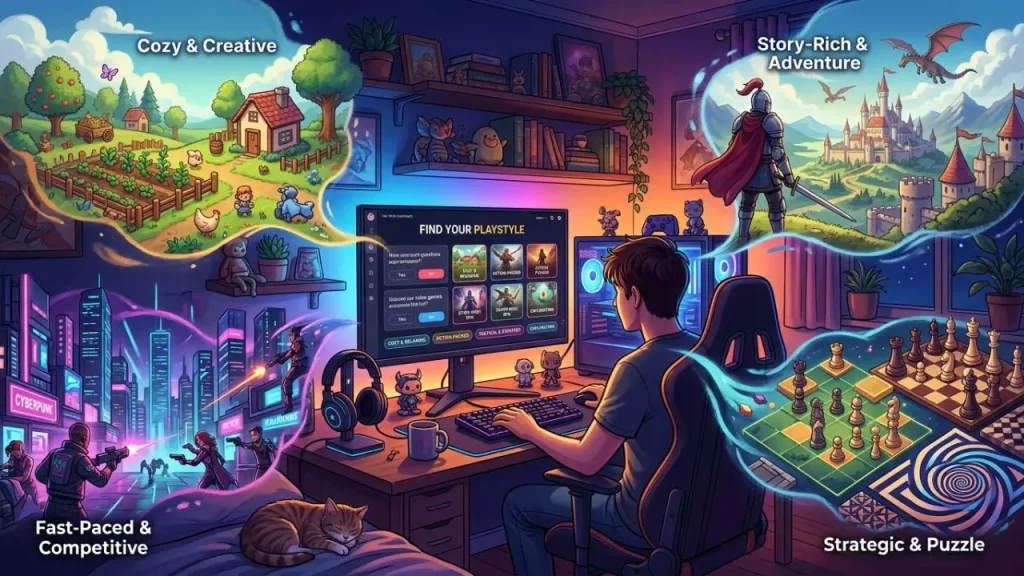
With such a vast selection available, choosing a new game can be difficult. A good starting point is to consider your own preferences. If you love stories, look for narrative-driven adventure games or RPGs. If you prefer fast-paced action, you might find more enjoyment in action or racing games.
You should also consider how much time you have available. An expansive RPG might demand many hours of your attention, whereas a puzzle or casual game can often be played easily in short sessions. There is no reason to choose a massive game if you only intend to play for ten or fifteen minutes a day.
Those who place great importance on plot and characters can look to lists of the best story-driven games of all time.
Consider difficulty and game pace
Difficulty level is another important factor. Some players enjoy games that constantly challenge them, while others prefer to relax and play without too much pressure. Many modern games offer various difficulty settings, allowing you to tailor the experience to your own skill level.
Control schemes should not be underestimated, either. A game might look interesting on paper but still fail to appeal if the controls feel awkward or uncomfortable. When exploring unfamiliar genres, it can therefore be wise to start with a simpler title.
Reviews and recommendations can help with your choice, but they shouldn’t be the only basis for your decision. Players have different tastes; a game someone else thinks is amazing won’t necessarily meet your own expectations. Personal interests remain the most important benchmark.
When choosing a game, you should consider not only the genre and platform but also age ratings and potential content. ESRB ratings can help you better assess a game in terms of age recommendations, content, and interactive features.
Conclusion
Games offer an exceptionally wide range of entertainment. From quick puzzle sessions, sports and strategy games, to expansive role-playing games and narrative-driven adventures, there are options to suit almost every taste.
The best choice depends on more than just the genre. Factors such as the platform, playtime, difficulty level, controls, and whether the game is single-player or multiplayer also play an important role. Taking these factors into account allows you to better tailor your choice to your personal needs.
Ultimately, games do not always have to be complex or massive in scope to be fun. A simple puzzle can be just as entertaining as a grand adventure. What matters most is that the game aligns with your interests, the time you have available, and the type of entertainment you are looking for.
Frequently Asked Questions About Games
1. What are games?
Games are activities with specific rules, goals, and challenges. The term can encompass both digital video games and other forms of play. In video games, the rules and the game world are implemented via software.
2. What game genres are there?
Well-known genres include action, adventure, role-playing games (RPGs), strategy, sports, racing, simulation, puzzle, and horror, as well as many hybrid forms. Many modern games also combine elements from multiple genres.
3. What is the difference between single-player and multiplayer?
In a single-player game, one person plays alone against challenges set by the game. In multiplayer games, multiple people can play together—either cooperatively or competitively—simultaneously or in turns.
4. Are mobile games only suitable for short play sessions?
No. Although many mobile games are designed for short sessions, there are also extensive games featuring complex systems, vast worlds, and long playtimes. The possibilities depend heavily on the specific title.
5. How do you find the right game?
It is best to start with your own preferences. If you enjoy stories, you might try adventure games or RPGs, whereas strategy fans might look for games involving planning and resource management. You should also consider the platform, available time, and desired difficulty level.
6. Are games merely entertainment?
Not exclusively. Games can also tell stories, offer creative tasks, require strategic thinking, or facilitate social interaction. However, depending on the game, their primary purpose remains entertainment and the gaming experience.
7. Which games are suitable for beginners?
Simple puzzle, casual, card, or adventure games can be suitable for beginners because their basic mechanics are usually easy to grasp quickly. Newcomers often benefit from games with straightforward controls and adjustable difficulty levels.
8. What makes a good game?
That depends on personal taste. A compelling combination of solid gameplay, intuitive controls, interesting challenges, atmosphere, and fitting content can make a game particularly entertaining.
9. Are multiplayer games better than single-player games?
There is no single “best” option. Multiplayer games can be great fun if you enjoy playing with others, whereas single-player games offer more peace and control over your own pace.
10. How much time should one spend gaming?
That depends on your personal situation. It is sensible to take regular breaks and ensure that gaming does not crowd out important tasks, sleep, physical activity, or social interactions. Balanced gaming habits ensure that games remain an enjoyable leisure activity.