
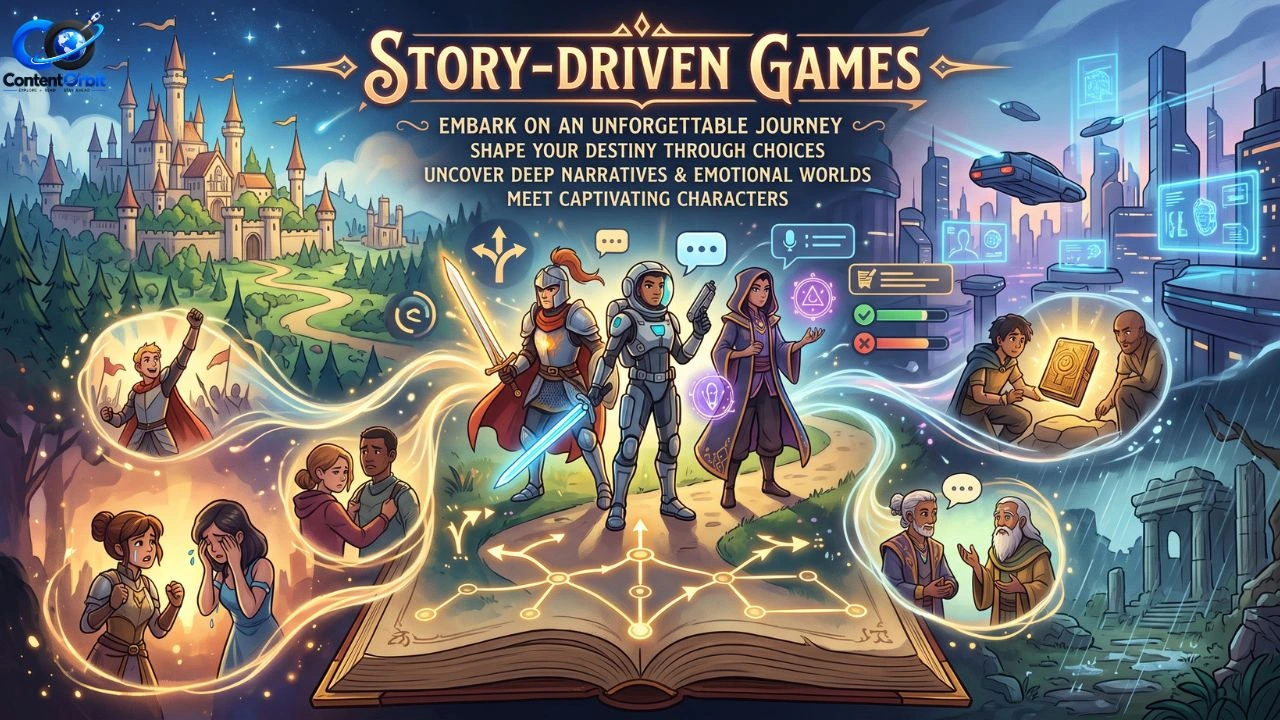

Story driven games are perfect for players who want more than action, competition, or high scores. These games put characters, emotions, choices, and interesting worlds at the center of the experience. Instead of simply completing levels, you become part of a journey and discover what happens as the story moves forward.
Some games make you feel like you are controlling an interactive movie. Others give you a huge world to explore, where side quests and small discoveries add more depth to the main story. Games such as The Last of Us, Red Dead Redemption 2, God of War, and The Witcher 3 show how powerful video game storytelling can be.
But what exactly makes a game story-driven? What types are available, and how can you choose the right one? This guide explains everything you need to know before starting your next narrative-focused game.
If you are looking for unforgettable narratives, memorable characters, and immersive worlds, check out our list of the Best Story Games of All Time.
Table of Contents
- What Are Story Driven Games?
- Different Types of Story Driven Games
- What Makes a Great Story Driven Game?
- How to Choose the Right Story Game
- Benefits, Drawbacks, and FAQs
What Are Story Driven Games?
Story driven games are video games where the story plays an important role in the overall experience. Characters, dialogue, relationships, missions, and events are used to move the player through a larger narrative.
In some games, the story is the main reason to keep playing. You want to discover what happens to the characters or learn the truth behind a mystery. In others, the story works alongside combat, exploration, puzzles, or role-playing elements.
For example, God of War combines action and combat with the relationship between Kratos and Atreus. The Last of Us uses survival gameplay while placing a strong focus on its characters and their journey.
How Are They Different From Other Games?
Not every game needs a deep story. Competitive games often focus on skill, teamwork, and winning. Puzzle games may focus on solving challenges, while sports games try to recreate real-world sports.
Narrative-focused games can include these same gameplay features, but they connect them to a larger story.
For example, fighting an enemy may not simply be about winning a battle. The enemy could be connected to the main character’s past or an important event in the story.
This connection between gameplay and narrative is what makes a good story-focused game feel more meaningful.
Why Do Players Enjoy Them?
A strong story gives players a reason to care.
When you spend several hours with the same characters, their successes and failures can start to feel important. A difficult decision may make you stop and think about what you would do in the same situation.
Story games can also create curiosity. You may finish one mission because you want to know what happens next, not simply because the game tells you to continue.
Story-driven games use different techniques to deliver their narratives, including cutscenes, dialogue, environmental storytelling, and in-game text. Learn more about the narrative of video games.
Different Types of Story Driven Games
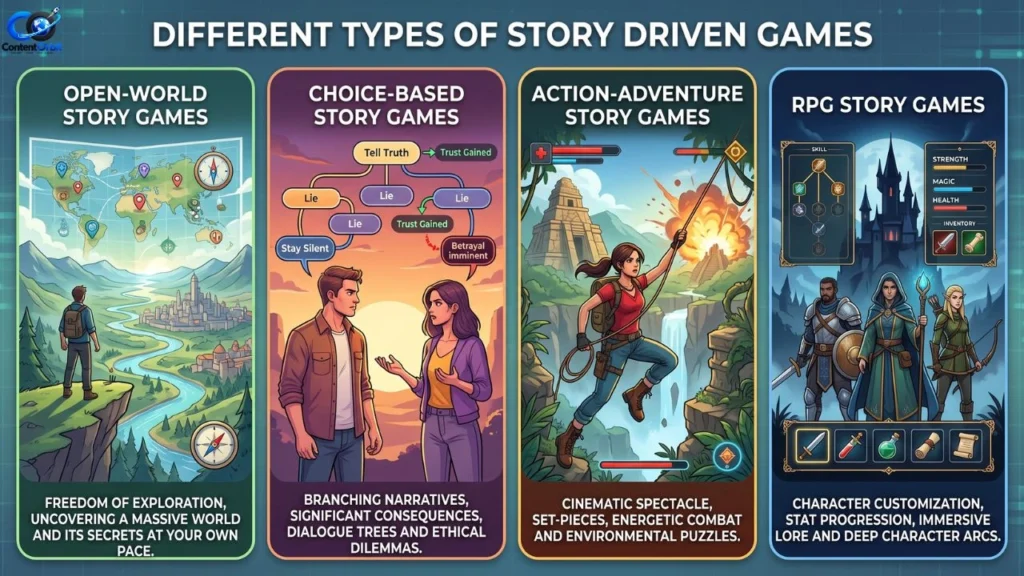
Story driven games come in many forms. You do not have to enjoy one particular genre to appreciate good storytelling.
Story-driven experiences are not limited to traditional games; many Best VR Games also use immersive worlds, characters, and interactive storytelling to keep players engaged.
Open-World Story Games
Open-world games give players a large environment to explore. You usually have a main storyline, but you can also discover side quests, characters, locations, and smaller stories.
Red Dead Redemption 2 and The Witcher 3: Wild Hunt are strong examples.
The main advantage is freedom. You can follow the main story or spend time exploring the world.
The downside is that large games can sometimes feel overwhelming. With so many activities available, players may lose track of the main story.
Choice-Based Story Games
Choice-based games make your decisions an important part of the experience.
You may choose what a character says, who to trust, or how to handle a difficult situation. Depending on the game, these decisions can affect relationships, missions, or endings.
Detroit: Become Human and Life Is Strange are good examples of this style.
These games are ideal for players who enjoy interactive storytelling and want to feel that their decisions matter.
Action-Adventure Story Games
Action-adventure games combine storytelling with combat, exploration, puzzles, and other activities.
God of War and Uncharted 4: A Thief’s End are examples of games that use cinematic storytelling without removing gameplay from the experience.
This is often a good starting point for players who want a strong story but do not enjoy games that are mostly dialogue.
RPG Story Games
Role-playing games, or RPGs, can provide some of the deepest and longest stories in gaming.
They often include character development, quests, equipment, exploration, dialogue, and choices.
Games such as The Witcher 3, Mass Effect, and Persona 5 Royal show how RPG systems can support large, detailed narratives.
| Type of Game | Main Focus | Best For |
| Open-world | Exploration and freedom | Players who enjoy discovering worlds |
| Choice-based | Decisions and consequences | Players who like interactive stories |
| Action-adventure | Combat and narrative | Players who want action and story |
| RPG | Characters, quests, and progression | Players who enjoy long adventures |
| Linear story | Focused narrative | Players who prefer a clear journey |
What Makes a Great Story Driven Game?
A long story does not automatically make a game good. A great narrative experience needs strong characters, interesting writing, good pacing, and a world that makes players want to keep exploring.
The best games also connect their story to gameplay. When your actions have meaning within the story, the experience feels more natural.
For example, if a character is searching for someone, the journey should feel connected to that goal. Side quests should ideally add something useful instead of feeling like random tasks.
Memorable Characters
Characters are often the most important part of a story.
A good character should have goals, problems, strengths, and weaknesses. They should change as the story develops.
Arthur Morgan from Red Dead Redemption 2 is a good example. His personality and changing view of the world are closely connected to the game’s larger story.
Strong World Building
World building is the process of creating a setting that feels believable and interesting.
A game can build its world through locations, conversations, books, signs, environmental details, music, and side missions.
A good world can make players curious even when they are not following the main story.
Good Pacing
Pacing means how quickly or slowly a story moves.
A game with constant action can become tiring. A game with too much dialogue can feel slow.
Good story games usually balance different types of moments. A major battle might be followed by a quieter section where characters talk or the player explores a new area.
This gives the player time to understand what is happening.
Meaningful Choices
Choices are most effective when they have consequences.
A game does not need hundreds of decisions. A few important choices can be enough if they change relationships, missions, or story events.
The best choice-based games make you think carefully instead of making the correct answer obvious.
How to Choose the Right Story Game
There are thousands of games with strong narratives, so choosing one can be difficult.
The easiest way is to first decide what type of experience you want.
If you enjoy exploring huge worlds, an open-world RPG may be a good choice. If you want a focused story with little distraction, a linear adventure may work better.
If you enjoy making decisions, look for games with branching stories or multiple outcomes.
Think About Your Preferred Genre
Ask yourself what you enjoy most:
- Action and combat
- Fantasy adventures
- Science fiction
- Horror and mystery
- Open-world exploration
- Role-playing
- Character relationships
- Choices and multiple endings
Knowing your preferred genre can quickly narrow down your options.
Consider the Game Length
Game length is also important.
Some story games can be completed in a relatively short time, while large RPGs can take many hours if you explore side content.
If you only have a small amount of free time, a shorter game may be more enjoyable. If you want a long adventure, an RPG or open-world title may be a better fit.
Check Whether It Is Part of a Series
Some games can be played without knowing anything about previous titles. Others are direct sequels.
Before starting a sequel, check whether the story continues from an earlier game. Playing the previous title is not always required, but it can make the characters and events easier to understand.
Do Not Pick a Game Only Because It Is Popular
Popularity does not guarantee that a game matches your interests.
A player who loves fast combat may not enjoy a slow detective game. Another player may consider that detective game one of the best experiences they have ever played.
Reviews are useful, but your own preferences should always matter.
Benefits, Drawbacks, and Expert Tips
Story-focused games have many advantages, but they also have some weaknesses.
Benefits
The biggest advantage is immersion. A good narrative can make a fictional world feel believable and meaningful.
Other benefits include:
- Memorable characters
- Interesting worlds
- Emotional moments
- Meaningful decisions
- Long-lasting experiences
- Different genres to choose from
- Strong single-player experiences
These games can also let you play at your own pace without the pressure of competing against other players.
Drawbacks
Some narrative games have long dialogue sections. Players who prefer constant action may find them slow.
Large RPGs can also require a lot of time. If you only play for a short period each day, it may take a long time to complete one.
Choice-based games can sometimes be frustrating because your decisions may lead to an unexpected result.
Expert Tips for Getting More From Story Games
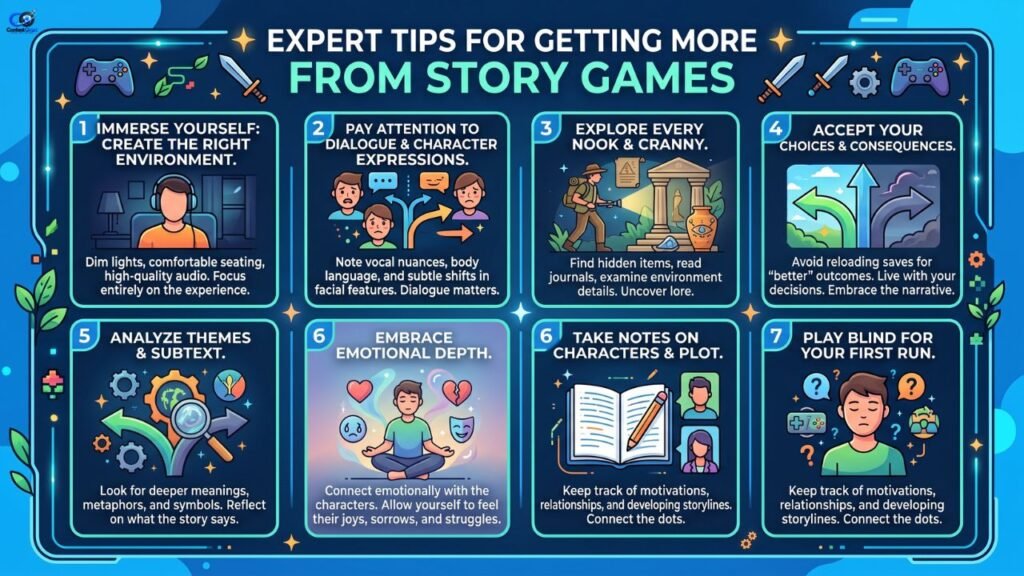
Do not rush through every mission. Take time to explore when the game encourages it.
Pay attention to conversations because small details can sometimes explain important parts of the story.
If the game has choices, think about what your character would realistically do instead of always searching for the “best” result.
Finally, avoid spoilers whenever possible. A major part of the fun in narrative games is discovering important events yourself.
FAQ About Story Driven Games
1. What are story driven games?
Story driven games are games where characters, narrative, dialogue, events, and relationships play a major role in the overall experience.
2. What is the best story driven game?
There is no single best game for everyone. Red Dead Redemption 2, The Last of Us, The Witcher 3, and God of War are popular examples of highly regarded narrative experiences.
3. Are story driven games worth playing?
Yes. They are especially good for players who enjoy characters, exploration, emotional moments, and single-player adventures.
4. Are story games always single-player?
No. Most narrative-focused games are single-player, but some multiplayer games also include stories, missions, or narrative events.
5. Are RPGs good for storytelling?
Yes. RPGs often provide detailed characters, quests, dialogue, exploration, and choices, making them a strong format for storytelling.
6. Do story games have multiple endings?
Some do, but not all. Choice-based games are more likely to have different endings, while linear games usually follow a more fixed story.
7. What are good story games for beginners?
Action-adventure games with straightforward controls and clear stories are often good starting points. Uncharted 4 and God of War are examples.
8. Can I play a sequel without the first game?
Sometimes. Many games explain enough of the previous story for new players, but playing earlier games can provide more background.
9. Are story games better than multiplayer games?
Neither is automatically better. Story games are good for players who enjoy narratives and solo experiences, while multiplayer games are ideal for competition and playing with others.
10. How can I find a good story game?
Start by deciding what you enjoy. Choose between action, RPG, horror, fantasy, science fiction, mystery, or open-world exploration. Then check the game’s story style and length.
Conclusion
Story driven games prove that video games can be much more than challenges, scores, and combat. A well-made narrative can introduce memorable characters, build fascinating worlds, and create moments that players remember long after finishing a game.
The best choice depends on your personal taste. Open-world fans may enjoy large adventures such as Red Dead Redemption 2 and The Witcher 3. Players who prefer emotional storytelling may enjoy The Last of Us, while those who like choices can explore titles such as Detroit: Become Human.
There is no perfect story game for everyone. Choose a game that matches your preferred genre, pace, game length, and style of storytelling. When gameplay and narrative work together, a video game can become an unforgettable experience.

[…] series is also an interesting example of [story-driven games], where characters, conversations, and exploration are more important than fast […]
[…] Co-op games are even more fun when they combine teamwork with a strong story, especially if you enjoy [story-driven games]. […]
[…] are an important part of Littlewood, which gives it some of the character-focused appeal found in [story-driven games]. You are not simply building empty houses. You meet characters, learn about them, help with their […]
[…] The game is much slower than modern action-horror titles, which makes it different from many story-driven games. Ammunition is limited, healing items are valuable, and the player must think carefully before […]
[…] story is especially interesting for players who enjoy story driven games, because his journey focuses heavily on friendship, family, sacrifice, and his battle against […]
[…] game combines a personal story with fantasy, exploration, and monster battles. If you like story-driven games, DQM: The Dark Prince might be of particular interest to […]
[…] Choo Choo Charles is a good choice for players who enjoy games with exploration, mystery, and a strong story. If you enjoy this type of experience, you can also explore our guide to story-driven games. […]
[…] Those who place great importance on a strong plot and interesting characters often find particularly intense gaming experiences in story-driven games. […]
[…] Those who particularly enjoy games with a strong world and a narrative atmosphere will find similar elements in story-driven games. […]
[…] Pokémon is one of those games that remain memorable not only for their mechanics but also for their characters and adventures—much like many other story-driven games. […]
[…] character development, and a larger world that makes the game particularly interesting for fans of story-driven games. Although their stories begin separately, they eventually converge into a shared battle for the […]
[…] simulator games are among the more relaxed games, while story-driven games focus more on plot and […]
[…] horror titles are also story-driven games, in which the story is an important part of the gaming […]
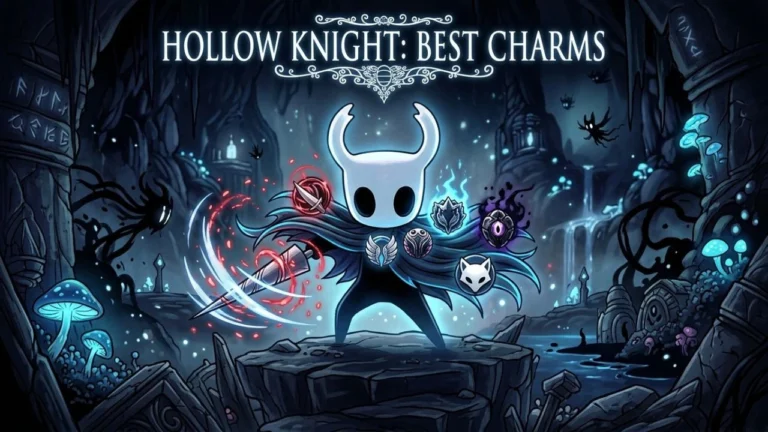
[…] Hollow Knight is interesting not only for its challenging combat but also for its world and the way the story is told through exploration. This makes the game a strong example of a story-driven game. […]
[…] Knight also demonstrates why story-driven games can be compelling not only through their narrative, but also through their world, atmosphere, and […]
[…] as Disco could be of particular interest to fans of story-driven games, where plot and character development play an important […]
[…] in story-driven games, interesting characters, personal conflicts, and a strong world can help players develop a deeper […]
[…] Aniimo combines an open fantasy world with creature collecting, combat, and exploration. If you are generally interested in games featuring a rich world and narrative elements, you can also read our overview of story-driven games. […]
[…] The story plays just as important a role as the action and horror. If you enjoy games with strong characters, a cohesive plot, and a grand narrative journey, you might also want to check out our guide to Story-Driven Games. […]
[…] If you are looking for games that place greater emphasis on plot and characters, you will find further interesting recommendations in our guide to story-driven games. […]
[…] Those who prefer games with strong narratives, interesting characters, and emotional stories will find a particularly large number of suitable experiences among story-driven games. […]
[…] those who want to experience exciting stories alongside short mental challenges, story-driven games—which combine adventure with narrative experiences—are a great […]