


Introduction
An NBA GM is one of the most important people behind a basketball team. GM stands for General Manager. This person is neither the coach nor a player. Instead, they are responsible for many important decisions regarding the roster, trades, contracts, and a team’s long-term planning.
When a team is looking for new players, wants to re-sign a star, or is planning a trade, the general manager is often directly involved. His decisions can determine whether a team competes for the championship or has to rebuild for several years.
For a broader look at the latest college basketball schedule and matchups, check out our guide to College Basketball Games Today.
In this guide, we’ll explain in simple terms what an NBA GM does, what his responsibilities are, how trades and contracts work, and what skills a good general manager needs.
Table of Contents
What Is an NBA GM?
The Key Responsibilities of a General Manager
NBA GMs and Roster Planning
What Skills Does a Good NBA GM Need?
Advantages, Challenges, and Key Decisions
Frequently Asked Questions About NBA GMs
1. What is an NBA GM?
An NBA GM is the general manager of a basketball team. He is part of the management team and works closely with the team president, the coaching staff, the scouts, and other staff members. His exact role may vary slightly from team to team.
Above all, the GM thinks long-term. A coach focuses more on games, practice, and tactics. The general manager, on the other hand, must consider which players will make the team better this year and in the years to come…
Here’s a simple example: A team has a young point guard but is struggling at the center position. The GM might look for a suitable center. Perhaps he’ll find a player through a trade, free agency, or the draft.
GM, Coach, and President—What’s the Difference?
These roles are often confused. However, they have different responsibilities.
| Position | Main Responsibilities |
|---|---|
| General Manager | Roster, contracts, trades, and long-term planning |
| Head Coach | Training, tactics, and lineup decisions |
| Team President | Overall athletic and business strategy |
| Scout | Identifies and evaluates players |
| Owner | Owns the team and makes key decisions at the highest level |
In practice, these roles may overlap. Some teams give their GM a great deal of power. In other teams, important decisions are made jointly with the president and the coach.
2. The Most Important Responsibilities of an NBA GM
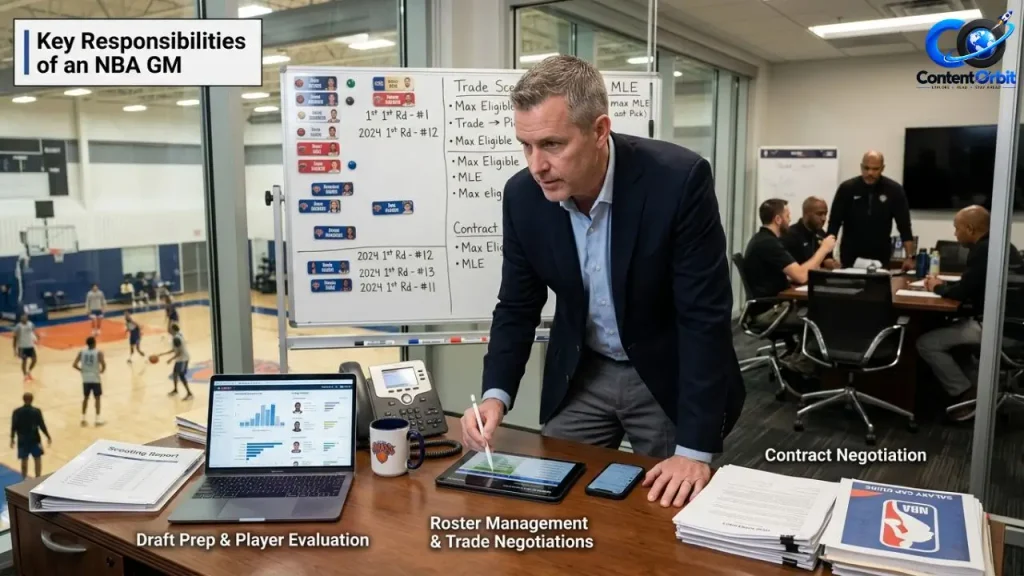
An NBA GM has many different responsibilities. It’s not just about finding good basketball players. He must also understand contracts, keep an eye on the budget, and plan for the team’s future.
One of the best-known responsibilities is roster management. The GM works with other team officials to decide which players will stay, which players will be signed, and which players might leave the team.
Trades and Transfers
Trades are among the most exciting tasks of a general manager. In a trade, NBA teams exchange players and sometimes draft picks.
A GM must answer several questions in the process:
Will the new player really improve the team?
Does he fit the coach’s style of play?
How expensive is his contract?
How old is the player?
Which draft picks will have to be given up?
What does the trade mean for the coming years?
A trade may look very promising in the short term, but it can cause problems in the long run. That’s why a good GM can’t just look at the current standings.
Free Agency
Free agency is also very important. During this period, certain players can sign new contracts with teams.
A team with plenty of salary cap space can try to sign a top free agent. However, the GM must be careful not to spend too much money on a single player.
A long-term contract can be difficult to modify later on. That’s why age, performance, injuries, role on the team, and expected development all play an important role.
NBA Draft
The draft is another key responsibility. Young players enter the NBA through the draft.
To this end, a GM works with scouts and analysts. They evaluate players from colleges, international leagues, and other competitions. They don’t just look at points.
Factors such as defense, height, athleticism, basketball IQ, shooting, passing, and potential for growth are also important.
A good draft pick can be incredibly valuable to a team. Young players with a good contract, in particular, can help a team achieve long-term success.
3. NBA General Managers and Roster Planning
Roster planning is probably one of the most difficult tasks a general manager faces. An NBA team doesn’t just need the best individual players. It needs players who work well together.
For example, a team may have several strong scorers. But if no one defends well or distributes the ball, the roster can still be unbalanced.
Finding the Right Mix
A good roster needs a variety of roles. These include, for example:
Stars who step up in crucial moments
Role players who reliably carry out specific tasks
Defenders who can stop strong opponents
Shooters who create space for other players
Young talents who can continue to develop
Experienced players who bring calmness and experience
The GM must bring these roles together. In doing so, he must also take into account the coach and his system of play…
Salary Cap and Contracts
The NBA has a complex system governing salaries and the so-called salary cap. Simply put, there are rules governing how much money teams can spend on player contracts.
“The official rules regarding contracts, the salary cap, and team expenditures are set forth in the NBA Collective Bargaining Agreement.”
For a GM, therefore, it’s not just a player’s athletic ability that matters. His contract also plays a major role.
For example, one player might be very good but have an extremely expensive contract. Another player might be a little less well-known but offer excellent value for the money.
The GM must therefore constantly balance athletic success with financial flexibility.
For example, one player might be very good but have an extremely expensive contract. Another player might be a little less well-known but offer excellent value for the money.
The GM must therefore constantly balance athletic success with financial flexibility.
Current Roster or the Future?
One of the biggest decisions is this: Should the team win now or plan for the future?
A team with several experienced stars could try to contend for the championship right away. To do so, it might make sense to trade draft picks or young players for an established star.
A young team, on the other hand, might choose a different path. It can develop its young players, accumulate draft picks, and wait for better years.
Both strategies can work. The problem is that no one knows exactly what the future holds.
4. What skills does a good NBA GM need?
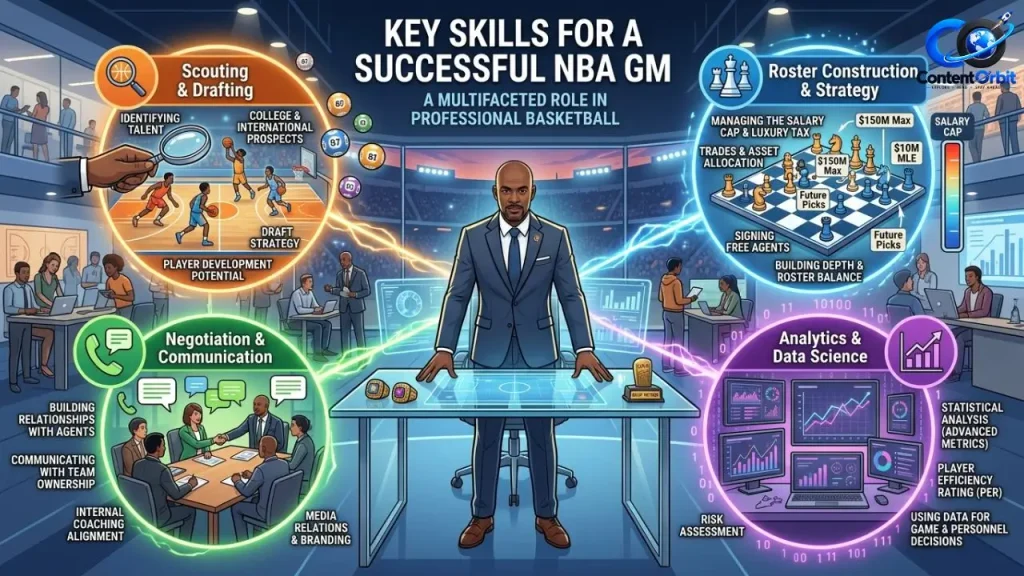
A successful general manager needs more than just basketball knowledge. The position combines sports, management, finance, communication, and long-term planning.
Understanding Basketball
A general manager must be able to evaluate players. He should be able to identify why a player is successful and whether that performance can be replicated on another team.
Statistics, video analysis, and discussions with scouts and coaches help with this.
Using Data Effectively
Modern NBA teams rely heavily on data. Statistics can reveal which players are particularly efficient or which combinations work well on the court.
However, data does not automatically replace human experience. A general manager must interpret the numbers correctly and combine them with scouting and observations.
Negotiation Skills
Negotiations are also important. A GM talks with players, agents, and other teams.
Topics include, for example, contract length, salary, roles, and trades. Good communication can help find better solutions for both sides.
Thinking Long-Term
One bad move can affect a team for years. That’s why a GM must consider various scenarios.
Before making a trade, for example, he should ask himself:
What can the player contribute right away?
What is the cost of the trade?
How long can the player stay?
Does he fit in with the current roster?
What opportunities does the team lose as a result?
These questions help avoid making emotional decisions.
5. Advantages, Challenges, and Key Decisions
The job of an NBA general manager can be very interesting, but it also comes with enormous pressure. Every decision is scrutinized by fans, the media, and experts.
A successful trade can make a GM a hero. A bad contract, on the other hand, can be criticized for years.
Benefits of the Position
Among the greatest benefits are:
Influencing the future of a team
Working with professional basketball players
Participating in trade and draft decisions
Collaborating with coaches and scouts
The opportunity to develop a comprehensive team strategy
The Biggest Challenges
The challenges are just as great, if not greater.
A GM has to work with a limited budget. At the same time, fans want to see success as quickly as possible. On top of that, there are injuries, fluctuations in form, and unexpected developments.
Even a good plan can fail. A young player might not develop as expected. A star player might get injured. Or a team in the same conference might suddenly become much stronger.
Common Mistakes Made by a General Manager

Some mistakes can be particularly costly.
Paying too much for a player: A high-value contract can later limit the flexibility of the entire team.
Thinking only in the short term: A team can improve in the short term but jeopardize its future if it trades away too many young players and draft picks.
Failing to select the right player: A talented player isn’t automatically the right fit for every team.
Misinterpreting statistics: Numbers must be viewed in the proper context.
Emotional decisions: A GM shouldn’t make moves just because fans or the media are putting pressure on him.
Expert Tip: Don’t Just Look at Names
A well-known player isn’t automatically the best signing. A good front office looks at what role a player can truly fulfill.
A lesser-known player can be very valuable to a team if he provides exactly what the roster is missing.
This is especially true for teams with limited budgets. Good roster planning often means finding several suitable players instead of signing a big name at any cost.
Frequently Asked Questions About the NBA GM
What does an NBA GM stand for?
NBA GM stands for NBA General Manager. The General Manager is primarily responsible for roster management, trades, contracts, draft decisions, and long-term sports strategy.
Is an NBA GM the coach?
No. The head coach is primarily responsible for training, tactics, and game preparation. The GM focuses more on the roster and management.
How does a GM decide which players a team needs?
He considers various factors. These include playing style, statistics, age, contract, position, injury history, and potential for development. GMs also consult with scouts and coaches.
Can an NBA GM trade players on his own?
A general manager can negotiate and organize trades with other teams. However, the final decisions that can be made depend on the structure of the team in question.
What makes a good NBA GM?
A good GM combines basketball knowledge with data analysis, negotiation skills, and a long-term perspective. He must understand risks and build a roster whose players work well together.
Conclusion
An NBA GM general manager plays a central role in building a basketball team. While he doesn’t decide which plays are run during a game, he has a significant influence on which players take the court in the first place.
From trades and free agency to the draft and long-term contracts, a general manager has to make many difficult decisions. It’s not enough to simply sign the most famous players. What matters most is whether a player is a good fit for the team, the coach, and the long-term strategy.
A successful GM therefore thinks several steps ahead. He combines scouting, statistics, finance, and basketball knowledge. It is precisely this combination that makes the position so challenging—and so fascinating for basketball fans…


Pingback: College Basketball Games Today: Games & Times Content Orbit