

Snake Game: Why This Simple Game Still Captivates Today
Snake Game is one of the most famous—and simplest—video games of all time. The basic concept is quickly grasped: a snake moves across a playing field, collecting food and growing longer in the process. The challenge lies in dodging obstacles and preventing the snake from colliding with itself or, eventually, the boundaries of the playing area. What initially sounds like a very simple pastime can become surprisingly demanding quite quickly.
It is precisely this blend of simple rules and increasing difficulty that makes Snake so compelling. It requires no complex controls, lengthy tutorials, or extensive prior knowledge; usually, arrow keys or simple swipes on a smartphone are all that is needed. Nevertheless, a good game demands concentration, quick reflexes, and a certain feel for movement. The situation changes with every point collected, as the snake takes up more space.
Another reason for its enduring popularity is the immediate feedback. Players see right away whether a decision has worked out. A wrong turn can end the round in a matter of seconds. At the same time, every successful stretch creates a desire to score just a few more points. This results in an uncomplicated flow of gameplay that is suitable for both quick breaks and longer gaming sessions.
How does the Snake game work?
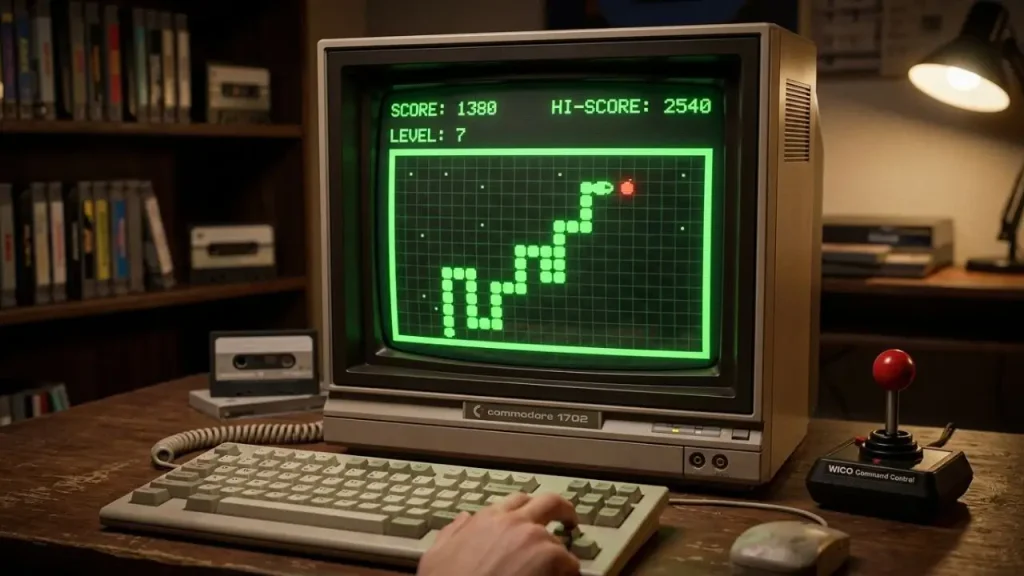
The classic Snake game is based on a very straightforward concept. A snake appears on the screen, usually moving continuously in one direction. The player can change its direction to reach a target—often represented by a small dot, an apple, or another symbol. Once the snake reaches the object, it collects it and grows longer.
This is precisely where the real challenge lies. A longer snake requires more space and cannot change direction as easily without getting in its own way. While a short snake can navigate small areas with ease, the player must plan much further ahead as the game progresses. It is no longer enough to focus solely on the immediate next target; one must also consider the path the snake might take afterward.
Key game rules
Classic versions usually follow three fundamental rules. First, the snake must collect food to score points and grow longer. Second, it must not collide with its own body. Third, depending on the version, touching the edge of the playing area can also end the game.
Modern variations may alter these rules. For instance, some versions allow the snake to reappear on the opposite side of the screen when it hits an edge. Others incorporate walls, moving obstacles, bonus items, or different playing field layouts. This preserves the familiar core concept while expanding the tactical possibilities.
Why does Snake get harder as the snake grows longer?
At the start, the player has plenty of open space. Changing direction is easy, and mistakes can often be avoided. As the snake grows longer, however, every move becomes more critical. The snake occupies an increasingly large portion of the playing area, while freedom of movement simultaneously decreases.
This creates an interesting interplay between reaction and planning. Beginners often focus solely on the next target. An experienced player, on the other hand, pays attention to which areas remain accessible after collecting a point. It is precisely this simple yet effective tactical layer that makes Snake more challenging than it appears at first glance.
The History of Snake
The idea behind Snake is older than many players realize. Various early games had already explored the concept of a growing line moving across a playing field. A frequently cited example is *Blockade*, an arcade game from the 1970s. In it, multiple lines moved across the screen, leaving trails that had to be avoided.
The game mechanic that would later become widely known as “Snake” evolved from these similar concepts. Various versions appeared on arcade systems and home computers during the 1980s. The technical implementation was far simpler back then compared to modern games. Nevertheless, the concept worked brilliantly because it did not rely on elaborate graphics. A small playing area, a moving line, and simple rules were enough to create an exciting challenge.
Snake on Mobile Phones
Snake became particularly famous thanks to mobile phones. Nokia played a pivotal role in this, popularizing the game on numerous devices. For many people, it was their first experience with a video game on a mobile phone. Controlling the game using the phone’s keypad was straightforward, and a round could be played practically anywhere.
The significance of this version extended beyond the game itself. Mobile phones at the time were far less powerful than today’s smartphones; complex 3D games were not the norm. Snake, however, demonstrated that a very small game could still be entertaining. This made it a staple of early mobile gaming culture.
From Simple Classic to Modern Variants
The spread of smartphones transformed the game of Snake. Touchscreens began to replace traditional buttons, while colorful new versions emerged featuring fresh playing fields, special effects, challenges, and various game modes.
Some modern variants focus on quick single-player rounds, whereas others incorporate multiplayer features or leaderboards. Certain games even blend the classic snake mechanic with elements from arcade, puzzle, or strategy games. Despite these changes, the core concept remains remarkably consistent: grow, avoid obstacles, and survive for as long as possible.
The Best Strategies for Higher Scores
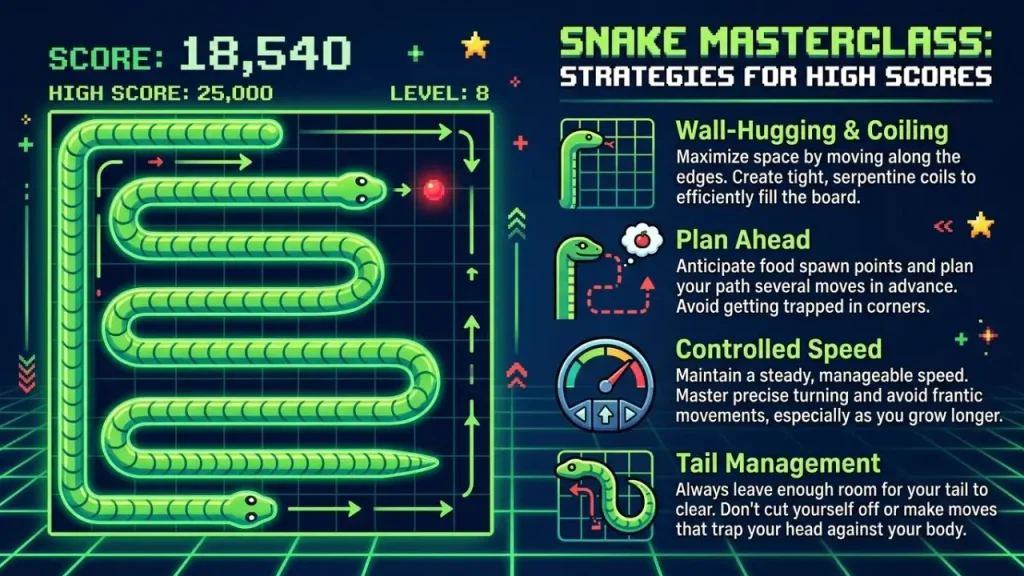
If you frequently fail early on in Snake, it is often not necessarily due to slow reflexes. More often, the problem lies in short-sighted planning. While food located right in front of the snake looks tempting, the quickest route isn’t always the safest. Taking a slightly longer path can be wiser if it ensures there is enough space left for your next move.
A sound basic strategy, therefore, is to look beyond your immediate target. Keep an eye on the area surrounding the snake as well. If sections of your own body are already positioned close together, avoid moving into that space. Especially with a long snake, a seemingly harmless change in direction can later lead to a dead end.
Make controlled turns
Many players change direction very frequently. While this might work at the start, it becomes riskier as the snake grows longer. Frequent changes of direction create complex movement patterns and can lead to your own body blocking your path.
It is often better to make controlled turns and deliberately utilize the available space. Your movement does not always have to be aimed directly at the next object. Sometimes it makes sense to take a wider loop first, positioning your snake so that you have more freedom of movement later on.
Don’t play too greedily
Another common mistake is chasing after every reachable bonus. As soon as an object appears, the player immediately tries to collect it. With a short snake, this behavior might be relatively safe, but it becomes problematic as the snake grows longer.
An easily accessible object is often more valuable than a bonus that requires taking a risky path. This is especially true when the snake already covers a large portion of the playing field. To achieve high scores in the long run, you shouldn’t just ask, “Can I reach this object?” A better question is, “Can I reach it and continue playing safely afterward?”
Snake on Modern Devices and in Various Versions
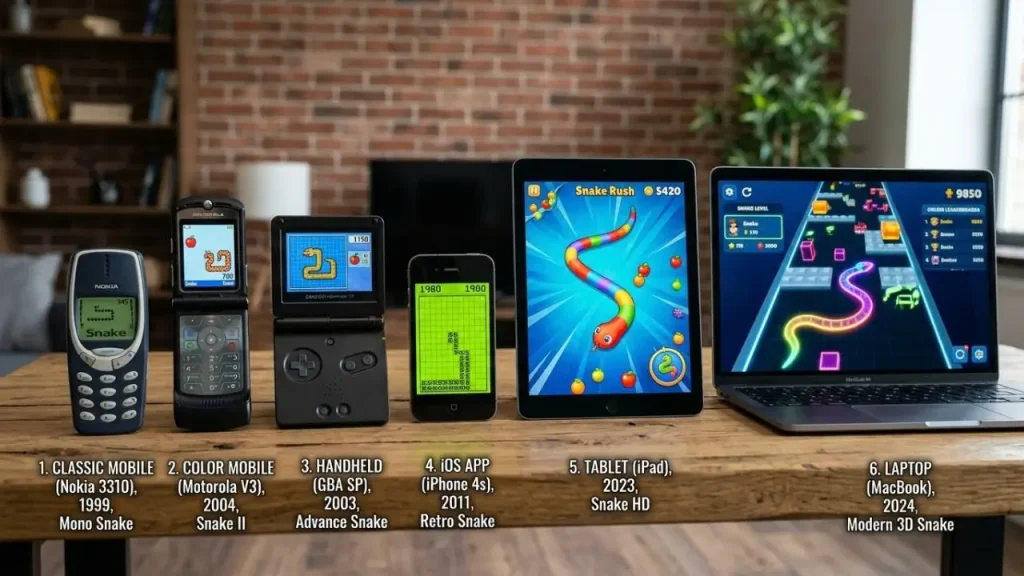
Today, Snake is no longer found solely on classic mobile phones; the game’s mechanics have been adapted for smartphones, tablets, computers, and various other platforms. Controls can range from keyboards and touchscreens to dedicated virtual buttons. This allows the familiar concept to be adapted to different devices without losing its fundamental simplicity.
On a computer, controls often feel particularly precise because direction can be managed directly via the arrow keys. On a smartphone, by contrast, swipe gestures or on-screen buttons might be used. Which version feels better depends largely on the specific implementation and personal preference.
Classic and Modern Game Variations
The classic version focuses almost exclusively on the snake growing in length. Modern games go much further; some versions offer multiple levels with varying playing field shapes, while others introduce walls, obstacles, or special bonus items.
Visuals have evolved as well. While older versions of Snake often consisted of just a few pixels or simple lines, modern adaptations can feature detailed backgrounds, animations, and diverse designs. Yet, the core concept remains recognizable, even when the visual presentation looks completely different.
Multiplayer Snake and New Challenges
Multiplayer variants offer a particularly interesting concept. In these versions, multiple snakes move simultaneously across the same playing field. Anyone wishing to discover more games that focus on playing together will find further examples in our overview of the best co-op games. Each player attempts to outlast the competition or collect more items than their rivals, adding an extra layer of tactical depth.
Players must not only control their own movement but also keep an eye on the positions of other snakes. An opponent might block a path or suddenly change direction, making anticipation and spatial awareness crucial. This transforms the simple single-player premise into a much more dynamic game.
Why Snake Remains Compelling Today
Snake’s strength lies not in elaborate storytelling or complex graphics. The game works because the rules are instantly understandable and the challenge begins immediately. A player can learn the controls in just a few seconds, yet achieving truly high scores can take a long time to master.
The game also demonstrates the effectiveness of a minimal set of rules. The player is given a clear objective, a confined play area, and escalating difficulty—elements that naturally create a challenge. There are no lengthy explanations and minimal distractions; every movement has an immediate consequence.
This makes Snake ideal for quick gaming breaks. A round can last just a few minutes, and players can try to beat their personal best at any time. At the same time, the game offers enough depth to experiment with different strategies; cautious players develop different movement patterns compared to those who deliberately take risks.
The nostalgia factor is also significant. For many, Snake evokes memories of a time when mobile phones were much simpler and small games were a staple of everyday life. Meanwhile, modern adaptations can introduce the concept to a new generation. It is precisely this blend of nostalgia and accessible gameplay that accounts for much of its enduring popularity.
Conclusion
The Snake Game proves that a video game doesn’t have to be complicated to remain interesting over the long term. The basic principle is easy to understand: the snake moves, collects objects, grows and has to avoid collisions. However, as the length increases, a greater strategic challenge arises.
From early arcade ideas to classic mobile phones to modern smartphone and multiplayer versions, the concept has changed many times. Nevertheless, the basic idea remained. If you want to achieve better results, you should not only react quickly, but also plan your movements in advance, save enough space and avoid unnecessary risks.
It is precisely this combination of simplicity, challenge and direct control that makes Snake a remarkably long-lasting gameplay principle. It can be learned quickly, but can only be mastered well with practice.
Frequently Asked Questions About Snake
1. What is Snake?
Snake is a game of skill in which you control a snake moving across a playing field. It collects objects, grows longer as a result, and must avoid colliding with its own body or specific obstacles.
2. How do you score more points in Snake?
You generally earn more points by collecting as many objects as possible and staying in the game for a long time. Controlled movement is crucial, as taking unnecessary risks can quickly end a successful round.
3. Why does Snake get harder as the snake grows?
The snake gets longer with every object collected, leaving less open space available. At the same time, changing direction becomes more challenging because the snake’s own body increasingly blocks parts of the playing field.
4. Can you play Snake on a smartphone?
Yes. There are numerous versions of Snake available for smartphones. Depending on the version, controls involve swiping, virtual buttons, or other touchscreen inputs.
5. What is the best strategy for Snake?
A good strategy is to play with foresight. Instead of just chasing the next object, you should ensure you maintain enough room to maneuver. Making controlled turns and avoiding unnecessary risks can help you achieve longer rounds.